Persian Literature, Ancient and Modern by Elizabeth A. Reed
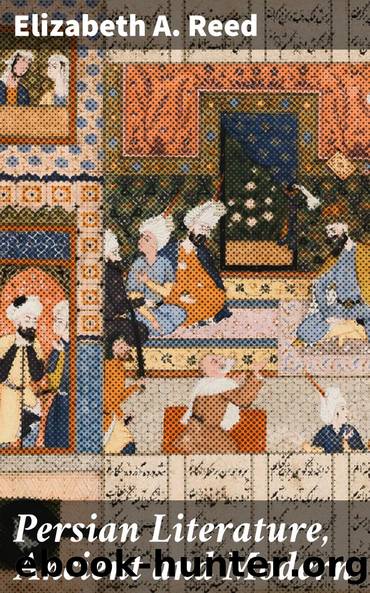
Author:Elizabeth A. Reed [Reed, Elizabeth A.]
Language: eng
Format: epub
ISBN: 9781983534607
Google: sR34swEACAAJ
Publisher: CreateSpace Independent Publishing Platform
Published: 2018-01-04T00:27:00+00:00
THE POEM.
This great epic, which was written under royal favor, though its author afterward suffered from royal scorn, is a valuable Persian classic. In the Persian tongue it exists only in manuscript form, and its text was corrupted by ignorant transcribers to such an extent that it excited the indignation of the sultan (a grandson of Timur, who reigned in the fifteenth century), and he collected a vast number of copies of the work; from these he had a transcript made, which was, perhaps, tolerably correct.
But since that time copies have been so greatly multiplied and their contents differ so widely, that it is only by a careful collation and comparison of manuscripts that scholars can hope to arrive at a reasonable degree of correctness. These manuscripts are finely executed and highly ornamental, having the frontispiece and titles beautifully illuminated and sprinkled with gold; the volumes are often profusely illustrated by colored drawings of exquisite finish. They cost about one hundred guineas, or about five hundred and twenty-five dollars each. But although these manuscripts can only be multiplied at such great expense, the original work has lived through eight centuries, and is still the most popular epic in the Persian tongue.
The author of the ShÄh NÄmah[237] has often been called the Homer of the East, FirdusÄ« occupying the same position in relation to other Persian poets that Homer has so long held in the West. Like Homer, too, he describes a rude age, where muscular strength and animal courage were chiefly valued. The correspondence is very striking between the old heroic times which were described by FirdusÄ« and Homer, and the pictures which are sometimes given us of the age of European chivalry. It is well known that the Moors carried into Spain the poetry and romance of Arabia and Persia, and some of our best fiction is supposed to be derived from that source.
Although FirdusÄ« wrote in the beginning of the eleventh century, it was not until the twelfth that the romances of chivalry began to amuse the Western world. The âOrlando Innamorato,â a poem by Bayardo, which was afterward improved and paraphrased by Berni, gave life and character to a great number of the stories of chivalry. In a similar way the ShÄh NÄmah was largely indebted to the BÅ«stÄn-NÄmah, which comprised the chronicles, histories, and traditions of the Persians, collected under the patronage of Yezdjird, the last king of the Sassanian race. Like the beautiful RÄmÄyana and the martial MahÄ-bhÄrata of the HindÅ«s, the ShÄh NÄmah claims to be a history in rhyme. It is supposed to comprise the annals and achievements of the ancient kings of Persia from KaiÅ«mers[238] down to the Saracenic invasion and conquest of that empire,[239] an estimated period of more than three thousand six hundred years. But this bold lyric can lay but little more claim to historic accuracy than can the HindÅ« epics whose gorgeous colorings mock the very name of history. The ShÄh NÄmah, like the other Oriental poems, abounds
Download
This site does not store any files on its server. We only index and link to content provided by other sites. Please contact the content providers to delete copyright contents if any and email us, we'll remove relevant links or contents immediately.
The Vikings: Conquering England, France, and Ireland by Wernick Robert(84379)
Ali Pasha, Lion of Ioannina by Eugenia Russell & Eugenia Russell(40318)
The Conquerors (The Winning of America Series Book 3) by Eckert Allan W(37983)
The Vikings: Discoverers of a New World by Wernick Robert(37006)
Cecilia; Or, Memoirs of an Heiress — Volume 1 by Fanny Burney(32636)
Cecilia; Or, Memoirs of an Heiress — Volume 2 by Fanny Burney(32010)
Cecilia; Or, Memoirs of an Heiress — Volume 3 by Fanny Burney(31996)
Empire of the Sikhs by Patwant Singh(23135)
The Secret History by Donna Tartt(19294)
Hans Sturm: A Soldier's Odyssey on the Eastern Front by Gordon Williamson(18649)
Cat's cradle by Kurt Vonnegut(15441)
Pimp by Iceberg Slim(14665)
Sapiens: A Brief History of Humankind by Yuval Noah Harari(14460)
Norse Mythology by Gaiman Neil(13457)
Talking to Strangers by Malcolm Gladwell(13439)
Leonardo da Vinci by Walter Isaacson(13411)
4 3 2 1: A Novel by Paul Auster(12511)
Underground: A Human History of the Worlds Beneath Our Feet by Will Hunt(12145)
The Radium Girls by Kate Moore(12093)
